Before I write this review I must admit to not being a big fan of Gilbert and Sullivan. I was introduced to their work at school via The Pirates of Penzance and, even in my early teens, I thought that the humour was very childish. I realise that it was supposed to be satirical, but it was definitely a product of its time – the end of the 19th century – when sophistication was not rife amongst the general population. The language also bothered me as being patronising to foreigners, even down to their names, so much so that I was surprised that any of their work was able to be performed in these days of airbrushing traditional art to conform with today’s attitudes rather than those of when the work was created. Although not to my taste, I believe that original versions should be preserved otherwise how will we ever learn from them. That is the end of the rant, now on to the review, which may come as a surprise after all I have just said.
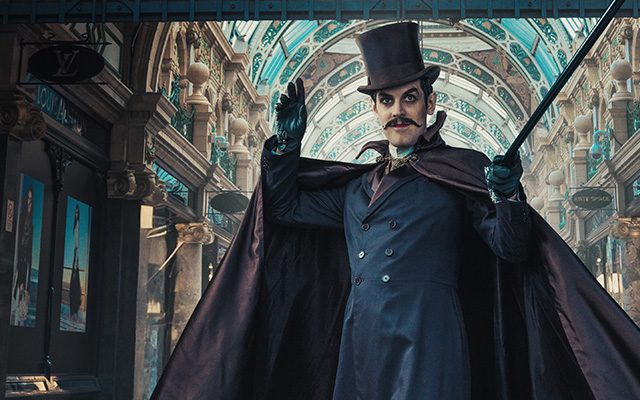
Although first performed in 1887, the action had been moved to the beginning of the 20th century, thankfully not the 21st! It opened with the projection onto a screen of the trailer to a silent film mocked up to show the cast. When this was done, the screen was raised and the set revealed, complete with music hall style footlights.

Ladies from the Chorus of Opera North moonlighting as professional bridesmaids trying to persuade Claire Pascoe, as Dame Hannah, centre, to get herself hitched.
The opening scene was the bed chamber of Rose Maybud as she awoke from her slumber. She was surrounded by the female section of the Chorus of Opera North, all dressed in white with flower fascinators. They were pleading with Miss Maybud to find herself a husband that day as they were professional bridesmaids and needed the dosh. They were having no luck with the other eligible woman, Rose’s aunt, Dame Hannah, as she was sworn to maidenhood having been betrothed to a man who turned out to be Sir Roderic Murgatroyd, whose family had been subjected to a curse that they must commit a crime every day or die a long and painful death. I told you it was silly, all he needed to do was move to a ULEZ – or Wales – drive round the block at 30mph first thing in the morning and the rest of his day was his own.

Amy Freston as Rose Maybud using her manual on etiquette to practise deportment.
There was one potential husband in the town, Robin Oakapple, who fancied Rose Maybud, and she was not exactly repelled by him. He was painfully shy, and she a stickler for etiquette, carrying a manual on the subject wherever she went and consulting it to see if her actions, and those of wannabe suitors, were in order. The book forbade her to make the first move and Robin was too shy to do so, resulting in stalemate on that front. The other problem was that he was really Sir Ruthven Murgatroyd, but had run away. His younger brother, Despard, assuming him to be dead, had taken the title of Baron and with it, the curse.

Henry Waddington as Old Adam and Dominic Sedgwick as Robin Oakapple
As luck would have it Robin’s faithful servant, Old Adam, tells him that his foster brother, a sailor named Dick Dauntless – really – has arrived in town and so he goes to meet him. When it comes to the ladies, Dick is not backward at coming forwards – I’m going to have to tread with care here – and Robin finds him regaling the females of the town with his stories. When they get together Dick offers to act as a go-between and tell Rose about his feelings for her. When Dick meets Rose he falls for her himself, you could see that coming a mile off, and she is quite taken by him. Robin warns her of the shenanigans practised by seafarers, well, some of them, and wins her affections.
Next on the scene is Mad Margaret, who is jealous of Rose after hearing that Sir Despard is planning to carry her off as one of his daily crimes, as she is in love with him. Enter a group of Hooray Henrys from the big city who are ‘welcomed’ by the bridesmaids. Not wishing to be left out of the partying, Despard arrives and scares everyone to death, until he is informed by Dick, as to the true identity of Robin. Despard is actually not very good at crime as he has a soft heart, so he is pleased to be shot of his role and abdicates his title in favour of the proper recipient, Robin.
This has the effect of his getting back together with Mad Margaret and Rose giving Robin the elbow to wed Dick. We were then treated to a well deserved interval.
The second act was totally different with the action taking place in The Picture Gallery at Ruddigore Castle, baronial seat of the Murgatroyds. As its name suggests, the walls of the gallery were covered in portraits of the present and former baronets.
Robin and Old Adam are now Sir Ruthven and his evil steward, who are even worse at committing crimes than Despard was, with their rap sheet making my suggestion sound like a capital offence, so much so that the subjects of the paintings spring to life as ghosts – if a ghost can spring to life – and order him to carry off a woman or face the consequence of the curse. Old Adam volunteers to go find a suitable victim.
Enter Despard and Margaret, now not so mad. They have morphed into a solidly respectable married couple devoted to do good works to atone. Despard points out to Ruthven that, although he has only done minor misdemeanours, he is still responsible for the acts committed by him during his false tenure. This so appals Sir Ruthven that he decides to reform and face the music.
Who else should Old Adam home in on to carry off but Dame Hannah. She turns on Sir Ruthven, who, in terror, calls on the spirit of Sir Roderic, who steps out of his picture frame and Dame Hannah recognises him as her long-lost beloved.
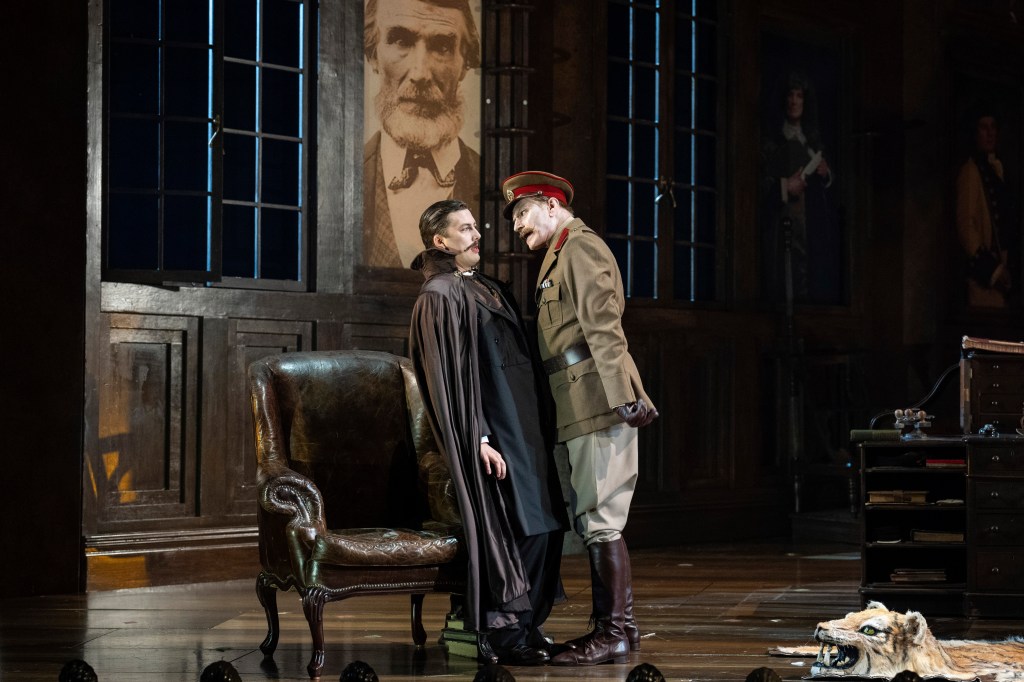
Sir Roderic, Steven Page, putting his point across to reluctant criminal Sir Ruthven, Dominic Sedgwick
Sir Roderic, who must have taken inspiration from Nick Freeman aka Mr Loophole, picks up on the fact that, as a baronet of Ruddigore can only die through refusing to commit a crime, then his refusal to do so would amount to suicide. Because in those days, suicide was a criminal offence, Roderic should not have died, having filled his daily quota. Problem solved and curse lifted. Roderick and Dame Hannah are reunited, as are Ruthven and Rose whilst Dick pairs up with Zorah, the Chief Bridesmaid.
I told you it was silly, and it was beyond daft really, but I must admit to being extremely impressed by the manner in which it was staged. The only way to make a production like this work is to play it relatively straight, as to mock the ridiculous would make it unwatchable. This was anything but, probably because the vaudevillian touches, such as the footlights, were a constant reminder that this was a show, rather than something to be taken seriously. The evil baronet was dressed in a manner straight out of central casting for a villain. Even Robin, once promoted to the rank of bart, miraculously grew a curly moustache and his hair seemed to darken by several shades.

Helen Évora as Mad Margaret and John Savournin as Sir Despard, post abdication.
Gilbert and Sullivan’s works were classed as operettas and, as such, were not performed in opera houses, but theatres, mainly the Savoy, so were not aimed at the intelligentsia, but the general public. When I was researching this I found that Mozart was one of the first composers to use the term operettas and he seemed to share my view, as he described them as being “certain dramatic abortions, those miniature compositions full of bullshit in which one finds only cold songs and couplets from vaudeville”. I have to say that Ruddigore, at three hours or so was not short, as G&S had expanded the length of their works, and neither were the songs cold, thanks to the warmth of the performers, who gave them a great deal of life, and energy.
I was also impressed by the dancing, which, again, reinforced the aura of a variety show and showed what an impressively talented group of artists Opera North has in their roster.
Amy Freston, as Rose Maybud, and a regular in the Chorus, excelled on promotion to the female lead in her singing, dancing and acting – operettas are also partly spoken. She exuded a kind of subdued sensuality, being prim and proper on the outside but mischievous and smouldering within. Dominic Sedgwick managed to carry the shyness of Robin across into his alter ego of Sir Ruthven, seeking ways to avoid too heinous a crime. Old Adam, played by Henry Waddington, however, seemed to shift from avuncular servant to maiden snatcher with relish. John Savournin as Sir Despard was the caricature villain but managed to keep a menacing air even in the more frivolous parts of the work.
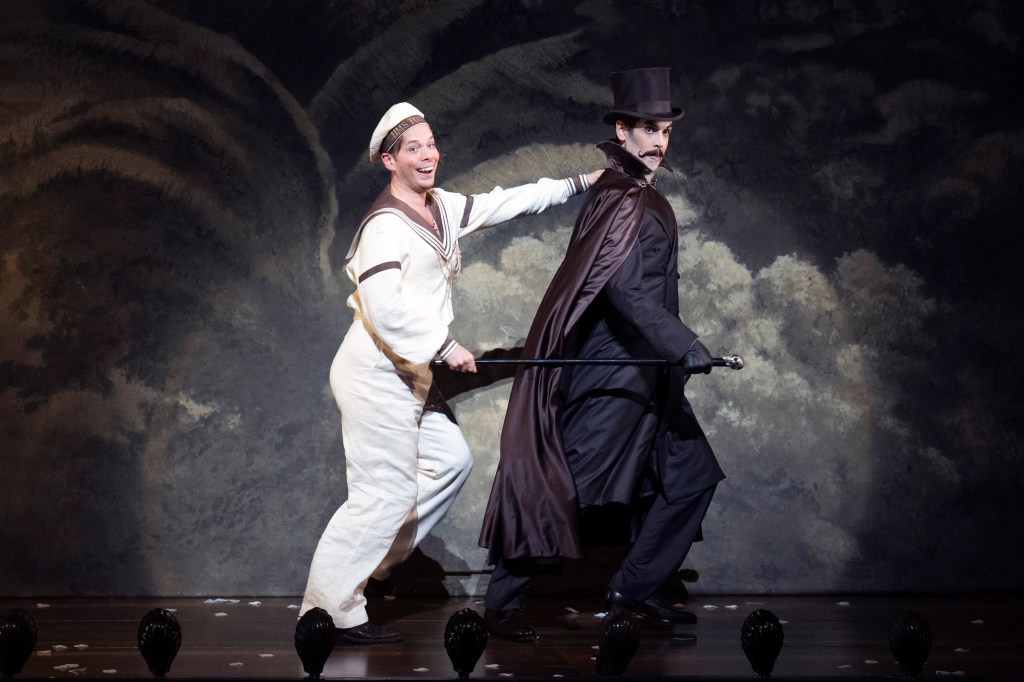
Dick Dauntless, Xavier Hetherington in dancing mood with Sir Despard, John Savournin
The parts of Dame Hannah, Claire Pascoe; Zorah, Gillene Butterfield and Mad Margaret, Helen Évora were comedy gold and, as such, were handled with some restraint whilst still being the objects of mirth. The showstopper, though was Xavier Hetherington, who played Dick Dauntless, whose acting, singing, dancing and acrobatics were full of character and humour, with the swagger associated with a sailor on shore leave making the most of his time on dry land. Finally, Steven Page as Sir Roderic, in army officer’s uniform, having come to life from his portrait, berating all and sundry before coming up with the final solution for the curse, gave the impression of a man not to be messed with so wouldn’t think twice before refusing to comply with his need to commit crime whatever the cost.
Ruddigore was Directed by Jo Davies who did a good job in mellowing my initial opinion of Gilbert and Sullivan, although I won’t be counting the days until my next exposure to their work.
The Set Designer, who did a brilliant job in both halves, was Richard Hudson; Revival Director was James Hurley – no idea. The Costume Designer, whose outfits were superb at striking the balance between the terror, formality and frivolity of the characters. Anna Watson was Lighting Designer, totally changing the mood between the lightness of the first act and the gloom of the second.
Kay Shepherd, Choreographer, made the most of the updating of the piece from 19th to early 20th century, in the music hall style of terpsichorean interpretation.
The Orchestra of Opera North were once again superb under the baton of Anthony Hermus and Leader, Katie Stillman. The Chorus Master was Anthony Kraus.
As you will know, I spend time listening to the audience as well as the work in question and I was amazed by the amount of laughter at things which were not in the least bit funny. It was not a matter of taste, as a few people guffawed when a character walked on stage, doing nothing in particular. I suppose these are the ones at whom operetta is aimed and I am pleased that they had a hilarious night out.
I mentioned The Pirates of Penzance earlier and there seems to be a Gilbert and Sullivan bingo card insofar as the music is concerned, there were the silly songs, a couple of semi serious ones, but this had not one, but two or three of their trademark ‘include as many words as you can in a song and then up the tempo to break-neck speed’ numbers. They are clever and test the performer, but not overly funny.
The other vital ingredient was a jingoistic element. Apropos of nothing in particular, this had a mock battle between the Union Flag and the French Tricolour. As we were settling down for Act 2 I spoke to the lady sitting next to me and asked what she thought of it so far, to which she replied she was finding it a bit hard to follow – in a broad French accent! She was from Paris but working in England at the moment. When I asked what she felt about the flag battle she just smiled and gave me a Gallic shrug of the shoulders.
Ruddigore is at Leeds Grand Theatre and Opera House on various dates until Saturday, 2nd November after which it tours to Newcastle Theatre Royal on 7th November, Lowry, Salford Quays on 14th November and Theatre Royal Nottingham on 21st November. For further details and to book, please go to https://www.operanorth.co.uk/whats-on/ruddigore/
To find out what else Opera North has in store it is https://www.operanorth.co.uk/whats-on
Photographs by Richard H Smith
 Tyke It To The Limit